What makes medical office buildings particularly well-suited for cost segregation?
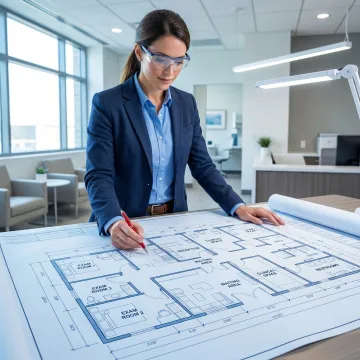
Medical office buildings contain a high concentration of short-life assets that most standard depreciation schedules ignore. Specialized electrical systems for medical equipment, exam room cabinetry, medical gas lines, plumbing for clinical use, HVAC upgrades, and tenant improvement build-outs frequently qualify for 5, 7, or 15-year depreciation often converting 20–40% or more of a building's cost basis into accelerated deductions.
How much can a medical office building owner expect to save in the first year?
Savings depend on the building's cost basis, construction quality, and the volume of specialized medical improvements. Seneca's average first-year client deduction is $171,243 across all property types. Medical office buildings, which tend to have above-average specialized fit-outs, frequently yield higher-than-average results. A free preliminary analysis will provide a tailored savings estimate for your specific property before any commitment.
Can I still do a cost segregation study if I purchased my medical office building years ago?
Yes. Seneca's Lookback Cost Segregation Study allows owners to claim all missed depreciation from properties placed in service up to 15 years ago in a single tax year using IRS Form 3115. No prior tax returns need to be amended. The lookback study costs approximately the same as a current-year study and includes the same engineering analysis, documentation, and audit defense coverage.
What is the minimum property value that makes a cost segregation study worthwhile for a medical office building?
Cost segregation typically becomes cost-effective for properties with a depreciable building basis starting at $300,000 (excluding land value). Most medical office buildings exceed this threshold comfortably. For properties near this threshold, Seneca provides a free preliminary analysis to confirm the study fees will be justified by the expected tax benefits before any work begins.
How long does a cost segregation study take for a medical office building?
Most Seneca studies are completed within 2–4 weeks, significantly faster than the industry standard of 4–8 weeks. If you choose our virtual property tour option, turnaround is typically 2–3 weeks. Rush service is also available for time-sensitive tax deadlines, with delivery in as little as one week. You'll receive a dedicated account manager throughout the process.
Do I need to have my physical building records available for the study?
Having architectural drawings, purchase agreements, construction or renovation invoices, prior depreciation schedules, and property tax records is helpful and speeds up the process. However, if original records are unavailable, Seneca's engineering team can reconstruct the necessary information using industry databases and historical cost data, ensuring a complete and accurate study regardless of documentation gaps.
What is included in Seneca's AuditDefense guarantee?
Every cost segregation study from Seneca includes the Seneca AuditDefense at no additional charge. If the IRS audits your return in relation to the cost segregation study, Seneca will provide all supporting documents, have cost segregation specialists respond to IRS inquiries, and handle all audit-related communications. This coverage lasts for the entire duration of your property ownership not just a limited window and includes a potential study cost refund if a material issue is found.
How does the virtual property tour work for medical office buildings?
The virtual tour is conducted via video call at a time convenient for you. You guide our engineering team through all areas of your medical office building while they conduct real-time component identification, classification, and digital documentation of building components. Virtual inspections typically take 30–45 minutes and result in faster turnaround times of 2–3 weeks, while also reducing overall study costs by eliminating travel expenses.
Which medical office components usually move to 5- and 15-year lives, and which stay at 39 years?
Items that serve specific equipment or the practice's operations, rather than the building, are usually 5-year property: dedicated circuits and outlets for imaging, lab and sterilization equipment, plumbing hook-ups that serve that equipment, readily removable floor coverings, decorative lighting and millwork, and movable casework. Parking lots, sidewalks, site lighting, landscaping and sign structures are 15-year land improvements. General lighting, central HVAC, restroom fixtures, permanent flooring, walls, ceilings, doors and the main electrical and plumbing systems stay at 39 years, unless an interior improvement qualifies as 15-year qualified improvement property.
How do bonus depreciation, qualified improvement property and section 179D work with a cost segregation study?
They stack. A study identifies 5-, 7- and 15-year property, which qualifies for 100% bonus depreciation if acquired after January 19, 2025. Interior improvements to a medical office building made after it was first placed in service, such as a tenant build-out, are generally qualified improvement property: 15-year property that is also bonus-eligible, though enlargements, elevators and the internal structural framework are excluded. Section 179D gives a separate deduction for qualifying energy-efficient lighting, HVAC and envelope work, but it ends for property whose construction begins after June 30, 2026, so only projects started by that date can still use it.
I own my medical office building and lease it to my own practice. Can the depreciation offset my practice income?
Often not directly. When you rent property to a business in which you materially participate, the self-rental rule in Treas. Reg. 1.469-2(f)(6) treats net rental income as nonpassive, but a net rental loss, including one created by cost segregation, generally stays passive. Passive losses can offset other passive income and are released when you sell. In some cases the rental and the practice can be grouped as one activity under Treas. Reg. 1.469-4, which can change the result. This depends on ownership and entity structure, so review it with your CPA before ordering a study.
What does a medical office building cost segregation example look like?
Illustrative only, with assumed numbers. A medical office building is bought for $3,000,000 with $600,000 allocated to land, leaving $2,400,000 of building basis. Assume a study reclassifies $360,000 to 5-year property and $192,000 to 15-year land improvements, and the building is placed in service in July. With 100% bonus depreciation, first-year depreciation is about $573,751: $552,000 of bonus plus $21,751 on the remaining $1,848,000 over 39 years. Without a study it would be about $28,248. Results depend on the building's actual fit-out and documentation.