This confusion is genuinely common — and understandable. Unlike most professional services, cost segregation fees don't follow a published schedule. No IRS guidance, no ASCSP rate card. The IRS Cost Segregation Audit Technique Guide says nothing about fee ranges — it focuses entirely on methodology, documentation quality, and preparer qualifications.
That's exactly where your evaluation should start, too. Price is a poor proxy for quality. What matters is whether the study follows IRS-required methodology, whether the preparer has engineering credentials, and whether you're protected if the IRS ever asks questions.
This guide breaks down what each price tier actually delivers, what legitimately drives fees up or down, and how to pick the right study for your property.
Key Takeaways
- Cost segregation fees typically range from $3,000 to $25,000+, driven by property complexity — not property value alone
- Fee size doesn't determine compliance — provider credentials and methodology do
- Audit risk comes from methodology and documentation quality, not from how much you paid
- Before hiring anyone, ask: Is the provider CCSP-certified? Are licensed engineers preparing the study? Is the fee fixed (not contingency-based)? Does audit defense come included?
What the $5K–$15K Range Actually Means
Cost segregation fees vary because no two properties are identical in complexity, documentation, or engineering scope. According to EisnerAmper, fees vary by the scope, size, and complexity of the project — not by any fixed industry schedule.
Two mistakes stem from misunderstanding this:
- Choosing the cheapest provider without checking credentials or methodology
- Assuming the most expensive firm automatically delivers better compliance or audit protection
Neither assumption holds. Here's how fees actually break down by property type and complexity.
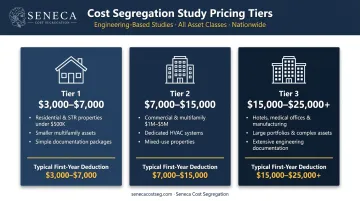
Tier 1: ~$3,000–$7,000 (Simpler Residential Properties)
Studies at this tier cover engineering analysis of residential or short-term rental properties, including basic component reclassification, documentation review, depreciation schedules, and a written report. This tier works well for:
- Single-family rentals and STR properties under $500K
- Smaller multi-family buildings (2–4 units)
- Properties with complete documentation and straightforward construction
A single-family rental in Las Vegas with a $420,000 building basis, for example, was reclassified at 33.14% through Seneca Cost Segregation — generating $41,832 in first-year tax savings at this fee tier.
Tier 2: $7,000–$15,000 (Mid-Size Commercial and Multifamily)
As property value and system complexity increase, so does the engineering scope. This tier covers detailed analysis of commercial or multi-family properties ($1M–$5M), virtual or on-site inspection, component-by-component cost allocation, a full IRS-compliant report, and audit support. It's the right fit for:
- Office buildings, retail centers, and apartment complexes (5–50+ units)
- Mixed-use properties
- Buildings with dedicated HVAC, specialty lighting, or custom buildouts
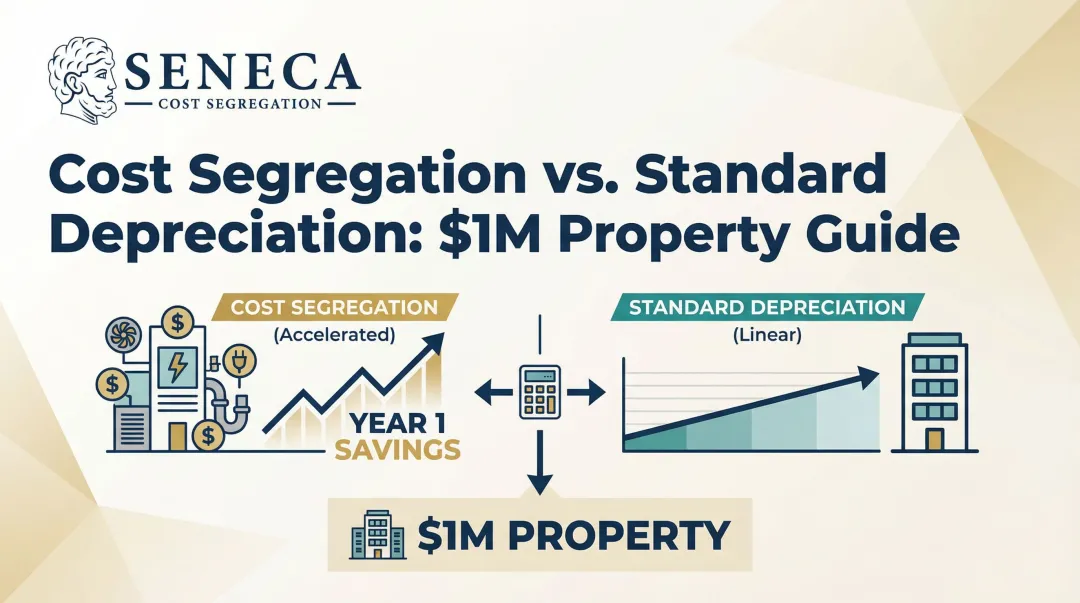
A $1M commercial property typically falls in the $7,000–$12,000 range. First-year deductions on properties at this level routinely return 5–10× the study fee.
Tier 3: $15,000–$25,000+ (Complex or High-Value Properties)
The highest tier reflects the most complex engineering work: large-scale analysis for properties over $5M, documentation reconstruction where records are incomplete, comprehensive tax strategy integration, and full audit defense. Properties that land here include:
- Hotels, medical offices, and manufacturing facilities
- Large apartment complexes and portfolios
- Properties with specialized systems requiring detailed component analysis
At this scale, properties in the $5M range can generate $1,000,000–$1,200,000 in first-year deductions — making a $15,000–$25,000 fee easy to justify.
What Actually Drives Cost Segregation Study Pricing
Legitimate pricing differences reflect scope, engineering effort, and credentials — not firm prestige. Knowing which factors justify a higher fee helps you evaluate quotes accurately.
Property Type and Complexity
A single-family rental has a limited number of reclassifiable components. A 40-unit apartment complex with dedicated HVAC systems, specialty lighting, custom millwork, and site improvements requires far more engineering hours. That difference in scope is the most significant driver of fees.
Medical facilities and hospitality properties sit at the high end — specialized equipment, unique infrastructure, and room-by-room analysis make these among the most time-intensive studies to complete correctly.
Property Value and Documentation Availability
Higher-value properties involve larger component inventories and more detailed cost allocation work. But documentation availability matters just as much.
Missing blueprints, absent contractor invoices, or no closing statement require engineers to reconstruct costs using industry databases — work that adds time and cost regardless of property value.
Provider Credentials and Methodology
The IRS Audit Technique Guide is direct: studies prepared by individuals with engineering and construction backgrounds are more reliable than those prepared without. CCSP-certified professionals through the American Society of Cost Segregation Professionals must log at least 7,000 hours of direct cost segregation experience over seven or more years.
That credential premium is justified — the IRS specifically requires engineering-based methodology and qualified preparer involvement. A lower-cost study from an uncredentialed provider using software-generated percentage tables produces a fundamentally different work product, regardless of how the report looks on paper.
Fixed vs. Contingency Fees
The IRS instructs examiners to closely scrutinize contingency-fee studies because they create an incentive to maximize Section 1245 asset classifications through aggressive interpretations. Reputable providers — including Seneca Cost Segregation — use fixed fees. That structure means the engineering analysis isn't influenced by how much the firm can claim on your behalf.
If a provider quotes you a percentage of your tax savings rather than a flat fee, treat that as a disqualifying factor.
Does Price Predict Quality?
The short answer: no. The IRS evaluates studies on 13 principal quality elements — none of which reference fee level. Those elements include preparation by a qualified individual, detailed methodology documentation, engineering take-offs and unit costs, cost reconciliation, legal analysis, and proper identification of Section 1245 property.
A $5,000 study from a CCSP-certified engineer with licensed staff can satisfy all 13 elements. A $15,000 study from a non-certified provider using percentage-table shortcuts may satisfy none of them.
Engineering Methodology: What "Engineering-Based" Actually Means
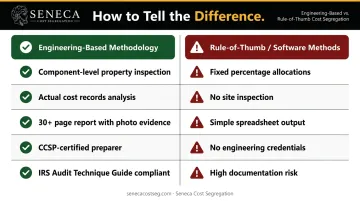
The IRS describes the detailed engineering approach from actual cost records as the most methodical and accurate approach. Rule-of-thumb percentage methods — where a provider assigns a fixed percentage of building cost to 5-year or 15-year property without component-level analysis — are viewed with caution and carry real documentation risk.
Some providers use "engineering-based" as a marketing phrase while relying on software models and industry averages. To distinguish genuine methodology from the imitation:
- Ask whether engineers physically or virtually inspect the property
- Request a sample report — engineering studies typically run 30+ pages with asset schedules, photo evidence, and legal analysis; percentage-table studies produce simple spreadsheets
- Ask specifically: "Do you use the detailed engineering approach from actual cost records?"
Audit Defense: What You're Actually Buying
Quality studies include documented audit defense at any price tier — but what that means in practice varies considerably by provider.
Seneca Cost Segregation includes AuditDefense with every study at no additional charge. If an IRS audit results in a depreciation adjustment greater than 5% caused by Seneca's work, they refund 100% of the study fee. That's a specific, enforceable guarantee — not just a promise to answer questions.
That same standard extends to delivery. Seneca typically completes studies in 2–4 weeks, accelerating when you can apply those deductions. Larger national firms often run 4–8 weeks due to internal review processes — a delay that costs you time on your tax savings, not just convenience.
ROI at Each Price Point: A Concrete Example
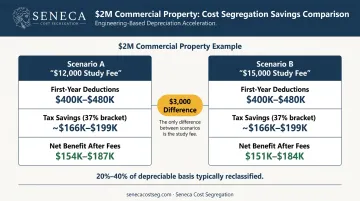
Consider a $2M commercial building. Based on typical reclassification rates, that property could generate $400,000–$480,000 in first-year deductions — translating to roughly $166,000–$199,000 in tax savings at a 41.3% combined tax rate.
Here's how fees affect the net outcome when deductions are identical:
- $12,000 study fee: Net investor benefit after fees ≈ $154,000–$187,000
- $15,000 study fee: Net investor benefit after fees ≈ $151,000–$184,000 — $3,000 less, with no added compliance protection or audit coverage
The deductions don't change. Only your take-home does.
Cost segregation studies typically allocate 20%–40% of depreciable basis to accelerated recovery periods, according to EisnerAmper. Seneca's average first-year deduction across all completed studies is $171,243 — a figure drawn from over 10,200 properties analyzed nationwide.
How to Estimate the Right Budget for Your Study
Start with your property's complexity, not the cheapest available quote.
Before requesting a quote, assess:
- Property type and size (residential vs. commercial, unit count, square footage)
- Documentation availability — do you have blueprints, contractor invoices, closing statements?
- Current-year acquisition vs. lookback candidate (prior-year properties need Form 3115)
- Whether you qualify as a real estate professional, which affects how passive loss rules apply to your deductions
A simple break-even framework:
If your combined federal and state tax rate is 40% and the study costs $10,000, you need $25,000 in additional first-year depreciation to break even in year one. For any property over $500,000 with eligible components, that threshold is almost always cleared — often by a wide margin.
Once you've run that math against your own property, the next step is getting a real number — not a range. Seneca provides a complimentary preliminary analysis before any commitment: a free savings estimate based on your property details, an ROI projection tied to your actual numbers, and a transparent fee quote so you can evaluate the decision with full information.
What Most Property Owners Get Wrong About Cost Segregation Pricing
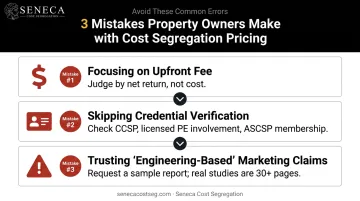
Most property owners evaluate cost segregation the wrong way — and it costs them. Here are the three mistakes that consistently lead to overpaying for an underperforming study.
Mistake #1: Focusing on the upfront fee instead of net benefit
A $10,000 study that generates $150,000 in deductions outperforms a $6,000 study that misclassifies assets and creates audit exposure. Judge the study on what it returns, not what it costs.
Mistake #2: Skipping credential verification
The IRS explicitly states that studies prepared by individuals with engineering and construction expertise are more reliable. Before signing any engagement, ask:
- Does the provider hold a CCSP designation?
- Are licensed professional engineers directly involved in study preparation?
- Can you verify active ASCSP membership?
These aren't formalities. They're the exact indicators the IRS points to when evaluating study quality.
Mistake #3: Assuming all "engineering-based" claims mean the same thing
This phrase has become marketing shorthand. A genuine engineering-based study produces a 30+ page report with photo evidence, detailed asset schedules, legal analysis, and a cost reconciliation tied back to your purchase price. A rule-of-thumb study produces a spreadsheet with percentage allocations.
Ask for a sample report before you commit. The difference will be immediately obvious.
Frequently Asked Questions
Is HVAC a 15-year or 39-year property?
It depends on function. Central HVAC serving the building as a whole is typically 39-year (Section 1250) property. Dedicated HVAC installed solely for a specific process or equipment — a server room or controlled manufacturing area, for example — may qualify as 5- or 7-year personal property under the IRS "sole justification" test. A licensed engineer makes that call correctly.
What does a cost segregation study typically cost for a $1 million property?
A $1 million commercial property typically falls in the $7,000–$12,000 range, depending on property type, documentation availability, and provider credentials. The study almost always pays for itself in the first year through accelerated depreciation, often by a significant margin.
Will a cheaper cost segregation study increase my IRS audit risk?
Audit risk is determined by methodology and documentation quality, not study price. A well-documented study from a CCSP-certified engineer carries no more audit risk at $5,000 than at $15,000. A low-cost study from an uncredentialed provider using percentage-table methods — regardless of price — creates real exposure.
What is the minimum property value for a cost segregation study to make financial sense?
Most specialists recommend a minimum of $500,000, with the strongest ROI at $1 million and above. Below that threshold, study fees can consume a larger share of the tax benefit — though short-term rentals and properties with high personal property percentages may still pencil out.
How long does a cost segregation study take to complete?
Most quality studies complete in 2–6 weeks — simpler properties with clean documentation on the shorter end, complex assets like hotels or medical facilities on the longer end. Ask for a firm delivery timeline upfront; earlier completion means earlier tax benefit realization.
What credentials should I look for in a cost segregation provider?
Look for the CCSP (Certified Cost Segregation Professional) designation from the ASCSP — the industry's primary credential, requiring at least 7,000 hours of direct experience. Also confirm that licensed professional engineers prepare the study, verify what the audit defense policy specifically covers, and request a sample report before signing.