
Real estate investors in 2026 face a genuine choice: virtual or on-site cost segregation. The decision isn't just about convenience. It affects your study fee, turnaround time, and — for the right property types — how many reclassifiable assets actually get identified.
Here's what this article settles: the IRS tax code doesn't change based on how your study was conducted. What changes is accuracy, cost, and documentation quality. That's what "which saves you more" actually means.
Key Takeaways
- Virtual studies cost less and work well for most standard residential and commercial properties
- Both methods follow the same IRS depreciation rules — provider quality determines your deduction, not which method you choose
- On-site studies offer stronger documentation for complex, high-value, or poorly documented properties
- With 100% bonus depreciation in 2026, accurate asset reclassification in Year 1 is more valuable than ever — provider quality is the most critical selection factor
- The right choice depends on property type, value, complexity, and documentation — not just upfront cost
Virtual vs. On-Site Cost Segregation: Quick Comparison
| Factor | Virtual Study | On-Site Study |
|---|---|---|
| Typical Fee | Lower — travel eliminated, faster setup | Higher — includes engineer travel, scheduling |
| Turnaround Time | 2–3 weeks | 4–6 weeks |
| IRS Audit Defense | Strong with engineering methodology and photo documentation | Marginally stronger — physical inspection records |
| Best Property Types | Standard commercial, residential rentals, multi-family, retail, office, self-storage | Complex facilities, specialized equipment, high-value or poorly documented properties |
| Asset Identification | Captures the large majority of reclassifiable assets on standard properties | Highest accuracy on complex or specialized properties |
On fees specifically, ASCSP 2024 case studies show on-site study costs at:
- $15,000 for a $10M apartment complex
- $20,000 for a $15M office building
- $30,000 for a $25M manufacturing facility
Virtual studies eliminate travel costs and typically cost less for equivalent property types.
What Is On-Site Cost Segregation?
On-site cost segregation is an engineering-based study where certified professionals physically visit the property to inspect, photograph, measure, and document all building components. It's been the industry standard for decades, and physical access is the reason it still commands a premium. Engineers can observe what blueprints don't always capture: custom installations, unusual mechanical systems, underground components, and restricted-access areas that remote analysis can miss.
How the Process Works
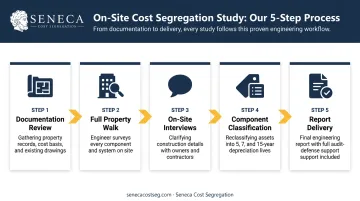
The on-site process typically follows this sequence:
- Initial documentation review — engineers gather blueprints, purchase agreements, contractor invoices, and existing depreciation schedules before the visit
- Full property walk — engineers access all areas including mechanical rooms, rooftops, and restricted spaces; they photograph and measure components directly
- On-site interviews — property managers are consulted about operational systems and custom installations
- Component classification — every identifiable asset is catalogued and assigned a depreciation category per IRS guidelines
- Report delivery — a complete engineering report with supporting documentation is delivered, typically within 4–6 weeks
When On-Site Is the Right Call
On-site studies are the stronger choice for:
- Properties over $5 million in depreciable basis
- Manufacturing plants, medical facilities, and industrial properties
- Hospitality properties with significant FF&E
- Historic renovations requiring Form 3115
- Any property where documentation gaps exist or construction records are incomplete
When a property has dense mechanical systems, custom build-outs, or older construction, the qualifying assets a physical inspection uncovers often exceed the fee difference between methods — sometimes by a significant margin.
What Is Virtual Cost Segregation?
Virtual cost segregation is a remote engineering analysis using digital documentation — photographs, video walkthroughs, cloud-shared blueprints, and engineering software — to classify assets without a physical site visit. Tools like BIM (Building Information Modeling) now enable structured asset classification at scale, making remote analysis as rigorous as a physical inspection for most property types.
A 2023 peer-reviewed study published in MDPI Buildings demonstrated a BIM-enabled automated cost segregation workflow that produced 45% higher NPV of depreciation and 236% higher first-year deductions compared to standard straight-line depreciation — illustrating how technology-driven remote analysis can deliver substantive results.
How Seneca's Virtual Process Works
Seneca Cost Segregation's virtual studies use a straightforward client process:
- Free feasibility consultation — property details are reviewed and a preliminary savings estimate is provided at no cost
- Documentation collection — closing statements, blueprints (if available), contractor invoices, existing depreciation schedules, and property photos are gathered
- 30–45 minute video walkthrough — the client guides Seneca's engineering team through all property areas in real time; engineers identify components and complete digital documentation live during the call
- Engineering analysis and report delivery — a full engineering-based report, fixed asset schedule formatted for CPA integration, and supporting documentation are delivered within 2–3 weeks
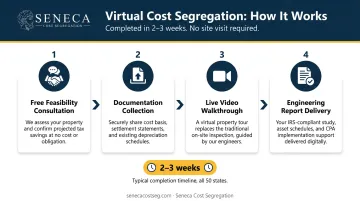
Seneca's virtual process is fully engineer-led. Every study uses an engineering-based methodology that follows the IRS Cost Segregation Audit Technique Guide — not automated software alone.
When Virtual Studies Make Sense
That process applies broadly. Virtual studies are the logical default for:
- Standard residential rentals and multi-family buildings
- Retail centers, office buildings, and warehouses
- Self-storage facilities
- Properties built after approximately 2000 with digital records available
- Investors managing multiple properties where compounding fee savings across a portfolio add up fast
For properties with solid existing documentation and standard construction, virtual studies deliver comparable results at lower cost and in roughly half the time.
Which Approach Actually Saves You More?
Here's the honest framing: both methods access the identical IRS tax code. The gross tax savings are driven by what gets reclassified, not by how the study was conducted. So "which saves more" really means which approach generates the highest net outcome for your specific situation — after accounting for study fees, reclassification accuracy, and turnaround speed.
Net ROI: Illustrative Comparison
Consider a $2M multi-family property where a cost segregation study reclassifies 20% of the depreciable basis — consistent with ASCSP residential case data.
| Virtual Study | On-Site Study | |
|---|---|---|
| Depreciable basis | $2,000,000 | $2,000,000 |
| Assets reclassified (20%) | $400,000 | $400,000 |
| First-year deduction (100% bonus) | $400,000 | $400,000 |
| Tax savings (37% rate) | $148,000 | $148,000 |
| Estimated study fee | $10,000–$15,000 | $15,000–$22,000 |
| Net first-year benefit | $133,000–$138,000 | $126,000–$133,000 |
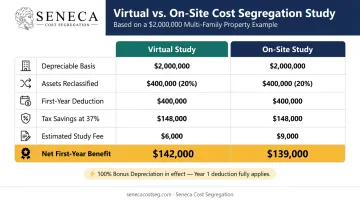
On a standard property like this, virtual generates a higher net ROI — same gross deductions, lower study fee. ### When On-Site Wins
On complex properties — specialized systems, high asset density, or documentation gaps — on-site engineers can identify assets that remote analysis would miss. Consider the ASCSP manufacturing case: a $25M facility with a $30,000 on-site study fee produced 30% reclassification — generating $4.4M in first-year tax savings. On that property, the on-site premium paid for itself many times over.
The rule of thumb: if missed assets on your property could plausibly exceed a $5,000–$10,000 fee differential, on-site is worth it.
Why 2026 Makes Accuracy More Critical Than Ever
With 100% bonus depreciation now in effect for qualified property acquired and placed in service after January 19, 2025 — per IRS Topic No. 704 — every dollar reclassified into 5-, 7-, or 15-year MACRS property is deductible in full in Year 1. Miss $50,000 in qualifying assets and at a 37% tax rate, you've left $18,500 on the table immediately.
One important caveat on state taxes: The Tax Foundation notes that only 17 states fully or fractionally conform to IRC Section 168(k). States like California and Michigan have effectively decoupled from the federal bonus depreciation provisions. Check your state's conformity status — federal and state tax outcomes may differ significantly.
What to Look for in Any Provider
These factors determine study quality regardless of delivery format:
- CCSP-certified professionals and licensed engineers on staff
- Detailed engineering from actual cost records, per the IRS ATG standard
- Audit defense backed by the study's documentation quality
- Formatted depreciation schedules and direct CPA support at no extra charge
Seneca Cost Segregation delivers engineering-based studies across all 50 states with CCSP-certified professionals. With 10,200+ completed studies, a 95% client referral rate, and an average first-year deduction of $171,243, the track record speaks for itself.
Real-World Scenario: A Multi-Family Virtual Study
Seneca completed a cost segregation study on Waverly Townhomes — a 35-unit, ground-up multi-family development in Albany, Oregon, placed in service in 2023 with a total improvement cost of $5,891,061.
Results:
- $1,403,836 in assets reclassified (23.76% of building basis)
- 19.77% to 5-year property, 3.99% to 15-year property
- $1,250,371 first-year deduction
- $423,006 in first-year tax savings at a 37% rate with 80% bonus depreciation
With 100% bonus depreciation now in effect, a comparable property placed in service today would generate even higher Year 1 savings. The study included engineering-based documentation and Seneca's AuditDefense guarantee, giving the investor full IRS defensibility regardless of delivery format.
Seneca offers complimentary feasibility assessments to help investors determine which study type fits their property before committing. The assessment requires basic property details — address, purchase date, purchase price, property type — and typically produces a preliminary savings estimate within 1–2 days.
Conclusion
For most residential investors and standard commercial property owners, virtual studies deliver equivalent tax savings at lower cost and faster turnaround. On-site studies remain the right call for complex, high-value, or poorly documented properties where the accuracy premium justifies the additional investment.
The delivery method is secondary to the provider's engineering credentials, compliance standards, and documentation quality. Evaluate both variables together when selecting a cost segregation firm — the study fee is only one part of the equation. In 2026, with full bonus depreciation available, a misclassified asset can cost you more in lost deductions than the difference between a virtual and on-site study combined.
When making your final decision, keep these priorities in order:
- Match the study type to property complexity, not just budget
- Verify engineering credentials and IRS-compliant methodology before signing
- Factor in audit defense and CPA support — not just the upfront fee
Frequently Asked Questions
Frequently Asked Questions
How much does a remote cost segregation study cost?
Virtual study fees typically range from $3,000–$7,000 for properties under $500,000 and $10,000–$20,000 for properties in the $1M–$3M range. Pricing varies based on property size, type, complexity, and documentation availability.
Is a remote cost segregation study legitimate?
Yes. Virtual studies are IRS-recognized when conducted with proper engineering methodology and documentation. The IRS Cost Segregation Audit Technique Guide (Publication 5653) does not require physical site visits as a statutory condition of legitimacy — it requires accurate, well-documented engineering analysis.
Can you do a remote cost segregation study on a residential property?
Yes, for investment properties. Multi-family buildings, long-term rentals, and short-term rentals all qualify. Primary residences do not — cost segregation applies only to income-producing property used in a business or rental activity.
What documentation do I need for a virtual cost segregation study?
Key items include your closing statement, current depreciation schedule, and property photos (interior and exterior). Blueprints, contractor invoices, and construction cost breakdowns help when available — but engineers can work with cost databases like Marshall & Swift when records are incomplete.
Which study method provides better IRS audit protection?
On-site studies offer slightly stronger physical documentation, but virtual studies backed by engineering-based methodology and thorough photo and video evidence hold up under IRS review. Provider quality and methodology matter far more than delivery format.
How long does a virtual cost segregation study take compared to on-site?
Virtual studies typically complete in 2–3 weeks; on-site studies take 4–6 weeks. The faster virtual turnaround can help investors capture deductions within the current tax year — particularly valuable when working toward year-end tax deadlines.