


Most property owners treat the cost segregation study as the finish line. It rarely is.
If you are a real estate investor looking to protect your accelerated depreciation deductions long-term, what happens after the study matters just as much.
Post-study support covers the ongoing documentation, audit defense, and tax compliance assistance your provider offers to keep those deductions intact when the IRS comes knocking.
So what is post-study support, and why does it matter to your bottom line? This article breaks it down.
What is Post Cost Segregation Study Support?
Post cost segregation study support is the ongoing professional assistance a cost segregation firm provides after your study report is delivered.
The study itself identifies and reclassifies building components for faster depreciation. Post-study support is what keeps those findings properly implemented, defensible, and useful over the life of your ownership.
It typically covers 3 core areas:
- Audit defense: Your provider represents you if the IRS reviews the study’s positions.
- Implementation assistance: Your CPA receives the fixed asset schedules, answers to their questions, and guidance on filing correctly, including Form 3115 preparation when needed.
- Ongoing advisory services: As your property changes and tax laws shift, your provider helps you continue capturing available savings.

When Do You Need Post Cost Segregation Study Support?
Several situations call for post-study attention. Some are predictable. Others catch property owners off guard.
You Face an IRS Examination
The IRS Cost Segregation Audit Technique Guide (Publication 5653, updated February 2025) outlines 13 elements examiners check in a quality study.
Studies that meet all 13 typically close at the preliminary stage without further action. But if your provider has no obligation to respond, you are left navigating that process alone.
You Renovate or Replace Building Components
Replacing a roof, HVAC system, or electrical infrastructure creates 2 opportunities:
- A partial asset disposition (PAD) election to write off the old component’s remaining depreciable basis, and
- Potentially a supplemental study on the new improvement costs.
PAD elections are time-sensitive. They must be claimed in the same tax year the asset is retired. Miss that window and the deduction is gone.
Timing also matters for the study itself. Whether you commission it before or after a renovation affects what documentation is available and how much you can recover.
Tax Laws Change
Bonus depreciation rates have shifted significantly in recent years.
Under the One Big Beautiful Bill Act (OBBBA), signed July 4, 2025, 100% bonus depreciation was permanently restored for property acquired and placed in service after January 19, 2025.
Properties acquired before that date remain on the TCJA (Tax Cuts and Jobs Act) phase-down schedule, which was 60% for 2024.
Post-study support ensures your implementation reflects whichever rules apply to your property.
You Previously Skipped a Study
A look-back study via Form 3115 lets you recover all missed depreciation in a single tax year without amending prior returns.
As u/CostSegSmart noted in a r/realestateinvesting discussion:
“A lot of investors think they missed the window if they did not do cost seg the year they bought. You can actually file a 3115 and catch up on all the depreciation you should have been taking in prior years, in one lump sum, without amending old returns.”
You Sell or Exchange the Property
When you sell a property, the IRS wants a portion of the tax savings you claimed back. How much it depends on what type of asset it was.
Personal property components get recaptured at your ordinary income tax rate, which can go up to 37%. Real property components are capped at 25%.
It adds up fast, and many owners are caught off guard at closing, which is why knowing your depreciation recapture tax rate ahead of time matters.
If you are doing a 1031 exchange instead of a straight sale, the math gets a bit more complex. The basis you carry over from your old property affects how much of the new one qualifies for bonus depreciation.
Without someone walking you through it, you can easily leave money on the table or end up with a surprise tax bill.
At Seneca Cost Segregation, post-study support includes full audit defense as part of every engagement, along with ongoing CPA coordination and guidance whenever questions come up.
If any of the situations above apply to your property, reach out to their team to talk through your options.
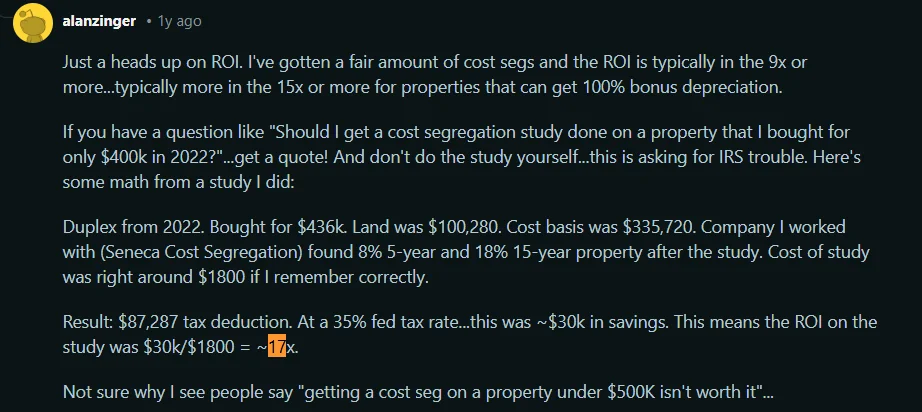
u/alanzinger shared in a r/realestateinvesting thread:
“I ended up going with Seneca Cost Segregation and have been happy with them. Seneca was patient with my questions. Virtual site tour was easy and the study was done in about 2 and a half weeks or so which felt about right.”
Their duplex study returned roughly 17x the cost in tax savings!
What Services Are Included in Post Cost Segregation Study Support?
Quality providers offer a range of services beyond the initial report.
| Service | What It Does |
|---|---|
| Audit defense | Defends asset classifications during IRS examination |
| CPA coordination | Provides schedules and answers questions for your tax preparer |
| Form 3115 preparation | Captures catch-up depreciation without amending old returns |
| Partial disposition studies | Determines the remaining basis for replaced building components |
| Repair vs. capitalization analysis | Identifies costs that can be deducted immediately under IRS TPR rules |
| Renovation studies | Reclassifies new improvement costs into shorter-life categories |
| 1031 exchange coordination | Reconciles carryover and excess basis post-exchange |
| Legislative update reviews | Adjusts implementation when tax law changes affect your study |
The IRS Tangible Property Regulations (finalized in 2013) added another layer of opportunity. When a property owner replaces a major building system, they can often write off the old system’s remaining basis immediately.
But this only works when the original study provided component-level cost data. Without it, there is nothing to base the election on.
Common Risks Without Post Study Support
Skipping post-study support creates real financial exposure:
- No audit protection: If the IRS questions your return and your provider has no obligation to defend their work, you are on your own. Your CPA can try to help, but they likely do not have the engineering background to explain why a specific component was classified the way it was.
- Missed partial dispositions: When you replace a roof or HVAC system and do not claim a PAD election in time, you lose the write-off permanently. The study gave you the data. Without support, there is no one helping you use it.
- Depreciation recapture surprises: When you sell, the IRS recaptures a portion of the accelerated depreciation you took. If you were not expecting it, the tax bill at closing can hit hard. Having someone walk you through this before you sell makes a real difference.
- Implementation errors: If your Form 3115 is filed incorrectly or your fixed asset schedules are applied the wrong way, the IRS can disallow your deductions. Under IRC Section 6662, the accuracy-related penalty alone is 20% of whatever you underpaid, plus interest from the original due date.
- Phantom assets: If a component you replaced years ago is still sitting on your depreciation schedule, you will owe recapture tax on it when you sell, even though it no longer exists in the building.
How to Evaluate a Cost Segregation Study Company
Choosing the right provider matters both before and after the study is complete:
- Look for engineering-based studies: The IRS is clear that studies done by construction engineers are more reliable than those done by someone without that background. If the firm you are considering does not have engineers on staff, that is a problem. You want someone who can physically inspect the property and accurately identify components.
- Confirm audit defense is included: A quality firm stands behind its work at no additional charge for as long as you own the property. If a provider does not offer audit defense or charges extra for it, consider it a deal breaker.
- Ask about post-study availability: The relationship should not end when you receive the report. Ask whether the team will answer your CPA’s questions, help you with partial dispositions down the line, and update your findings if tax laws change.
- Check their experience: Ask how many studies they have completed, what property types they work with most, and whether they can point you to CPA firms they have worked with. More experience across more property types generally means a more reliable study.
Some providers are easier to spot as the wrong choice than others. Before signing anything, watch out for these red flags:
- Guaranteed reclassification percentages before reviewing any property documents
- Identical results across very different property types
- No site visit or physical inspection for complex properties
- Fees that seem far too low for real engineering work
- Audit defense that is not included in writing
- Contingency fee structures, which the IRS ATG explicitly flags as a concern
- No clear answer on who actually prepares the study and what their qualifications are
Beyond what is covered here, real property owners in 2 active Reddit threads on evaluating cost segregation firms (mentioned above) and choosing the best cost segregation provider shared some sharp observations worth noting:
- u/Samtyang: “The biggest trap is chasing the largest depreciation number. What actually matters is whether your CPA feels comfortable signing the return and defending the study later.”
- u/nuebauser: “Ask the firm upfront how they handle component-level detail. Some firms lump categories together in ways that make it harder to track partial dispositions later when you replace something like an HVAC unit.”
- u/kinderCPA: “As a CPA, I care a lot less about maximizing depreciation and a lot more about whether I am comfortable standing behind the report.”
- u/greedo47: “If a firm only talks about first year savings, that is a red flag for me.”

Frequently Asked Questions (FAQs)
Below are some of the most common questions property owners ask about cost segregation.
Is Cost Segregation Worth It?
For most qualifying properties, cost segregation is worth it. You are moving deductions earlier, which puts real cash back in your pocket now instead of waiting 27.5 or 39 years.
When Does Cost Segregation Make Sense?
Cost segregation makes the most sense when your property has a depreciable building basis of at least $300,000, and you plan to hold it for at least 3 to 5 years. You also need a tax situation that lets you actually use the deductions.
u/jmo15, a CPA, put it in a r/tax discussion on cost segregation:
“It is just a deferral of tax. If you are in a high-income year, then yes it would make sense to try and reduce your taxable income. If you are in a loss this year, then it would not make sense. It is not one size fits all.”
Real estate professionals, active short-term rental operators, and investors with passive income tend to see the strongest results.
Can You Do Cost Segregation on Residential Rental Property?
Yes. Cost segregation on residential rental property works for single-family rentals, duplexes, apartment complexes, and short-term rentals.
Components like flooring, appliances, cabinetry, and landscaping can be reclassified into 5-year or 15-year categories instead of depreciating over 27.5 years.
How Much Does a Cost Segregation Study Cost?
The cost of a cost segregation study depends on your property type, size, age, and complexity. Smaller residential properties tend to cost less, while larger commercial properties can run significantly higher.
The fee is tax-deductible, and in most cases, your first-year tax savings cover it many times over.
Can I Do My Own Cost Segregation Study?
Yes. Technically, you can do your own cost segregation study. But most CPAs will not file a return based on one because they take on personal liability for what they sign. A professional engineering-based study is also far more likely to hold up if the IRS ever takes a closer look.
Professional studies also tend to uncover more deductions than simplified approaches.
Conclusion
Every year that passes is a year of accelerated depreciation that cannot be recovered. Most property owners are already leaving significant tax savings on the table without realizing it.
Seneca Cost Segregation’s engineering-based studies have helped property owners across all 50 states unlock an average first-year deduction of $171,243. They have completed over 10,200 studies and counting.
Every study is handled end to end, coordinated directly with your CPA, and backed by a full audit defense and money-back guarantee.
The savings are there. You just have to request a free proposal today to get started.

